


Harnessing the “Male Effect” and “Male-to-Male Effect” for Simultaneous Fertility Boosts in Your Herd
For many of us who cherish our goat herds, the ebb and flow of the breeding season can feel like an unyielding rhythm, primarily dictated by the sun’s journey across the sky. Most goat breeds, especially those in subtropical latitudes, experience distinct seasonal shifts in their reproductive cycles, with their endocrine function, sexual behavior, and overall reproductive activity largely governed by the amount of daylight they receive, a phenomenon known as photoperiod. Yet, what if we told you that the secret to stimulating sexual activity, even during the quiet non-breeding months, lies not just in the environment, but in the lively social interactions among the goats themselves? This fascinating concept, explored in a recent study, delves into how sociosexual cues can dramatically modulate this seasonality, offering exciting prospects for goat management.
Indeed, you might already be familiar with the renowned “male effect,” a powerful tool in reproductive management where the mere presence of sexually active male goats rapidly triggers a cascade of events in seasonally anestrous does, including the secretion of luteinizing hormone (LH), the display of estrous behavior, and ultimately, ovulation, typically within a mere five days of contact. The efficacy of this effect, however, isn’t uniform; it’s profoundly influenced by the intensity of sexual behavior exhibited by the male goats. Simply put, bucks that are already in their prime, sexually active (SA) due to photoperiodic treatments during the non-breeding season, are far more potent in stimulating LH secretion and ovulation compared to their untreated, seasonally hypoactive (SH) counterparts.
But the story doesn’t end there, and this is where it gets truly intriguing for herd managers. Recent groundbreaking research has unveiled a complementary phenomenon: the “male-to-male effect”. It turns out that those same highly active SA male goats are also incredibly effective at stimulating other male goats, even those in sexual rest. Through this unique interaction, SA males can boost LH and testosterone secretion, enhance sexual behavior, and even increase sperm production in SH male goats during the non-breeding season. Imagine the possibilities! In fact, previous studies have demonstrated that male goats, when stimulated for about a month solely through this “male-to-male effect” (without direct photoperiodic treatment), proved just as effective in inducing reproductive activity in anestrous does as those directly stimulated by photoperiod. Both groups achieved impressive pregnancy rates, often exceeding 90%, with no significant differences between them. This suggests a powerful, indirect way to prepare your males for breeding.
Given these discoveries, the recent study aimed to answer two pivotal questions for the practical goat owner: Can sexually active male goats, stimulated by photoperiod, simultaneously jumpstart reproduction in both does and other males when they’re all housed together in the same flock during the non-breeding season? And, equally important, can male goats stimulated by the “male-to-male effect” fertilize does with the same efficiency and within the same timeframe as those males who received direct photoperiodic stimulation?. The researchers hypothesized that, yes, SA male goats could indeed stimulate both sexes concurrently, and that male-to-male stimulated bucks would prove just as capable of successful fertilization.
To put these hypotheses to the test, the researchers conducted an elegant experiment in the Laguna region of northern Mexico, an area where day length varies significantly, contributing to a non-breeding season for males from January to May and for does from March to August. They prepared sexually active (SA) male goats by exposing them to artificial long days (16 hours of light daily) from November 1st to January 15th. A control group of seasonally hypoactive (SH) males remained under natural photoperiod. Multiparous does, confirmed to be in seasonal anestrus, were divided into four carefully balanced groups.
The experiment, starting in April, involved introducing various male groups to the does for 18 days. One group of does, previously isolated, was joined with two SA male goats (the SA group). Three other groups, which had initially been housed with SH male goats, were then managed differently: one group was joined with two SA male goats (SA + SH group); another was joined with two SA male goats fitted with aprons to prevent mating (SA-apron + SH group), meaning only the existing SH males could fertilize; and a final control group was joined with two additional SH male goats (SH + SH group). Their behaviors were monitored by recording “nudging” events, a clear indicator of sexual activity in male goats, both on the day of introduction (D0) and the following day (D1).
The results were compelling. On D0, SA male goats displayed significantly more nudging events than the SH male goats in the other groups. By D1, nudging had increased across all groups except the SH + SH group. Notably, the SH male goats housed with SA males (in the SA + SH and SA-apron + SH groups) showed a significant increase in their sexual behavior, unlike those in the SH + SH group. This strongly suggested that the SA males were indeed stimulating the SH males.
The reproductive outcomes were even more striking. The percentages of does that ovulated, became pregnant, and ultimately kidded did not differ significantly among the SA, SA + SH, and SA-apron + SH groups. However, all three of these groups demonstrated significantly higher ovulation, pregnancy, and kidding rates compared to the SH + SH control group. This immediately tells us that the presence of SA males, whether alone or mixed with SH males, dramatically improves reproductive success in does during the non-breeding season.
Perhaps the most pivotal finding for understanding the “male-to-male effect” comes from the SA-apron + SH group. In this group, the SA males wore aprons, making it impossible for them to mate with the does. This meant that any successful fertilizations in this group could only have been achieved by the SH male goats, who were being stimulated by the SA males. The fact that fertility rates in the SA-apron + SH group were comparable to those in the SA and SA + SH groups unequivocally demonstrates that SH male goats, stimulated by SA male goats, successfully fertilized the does with the same efficiency. This is monumental! It suggests that within just a few days of being exposed to SA males, SH males not only induced ovulation and estrous behavior in does but also rapidly recovered their fertilizing capacity. The interval between male introduction and parturition was also similar across these effective groups, indicating synchronized pregnancies.
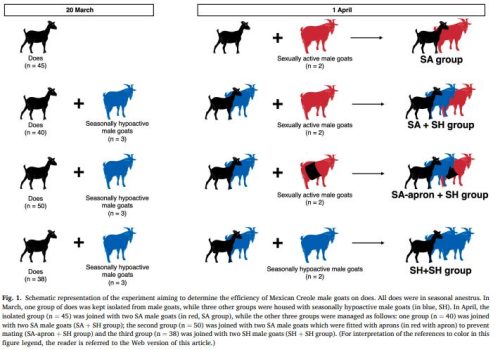
This study powerfully concludes that SA male goats can, during the non-breeding season, simultaneously stimulate the reproductive activity of both does and other male goats when housed together. This is achieved through the combined forces of the “male effect” and the “male-to-male effect”. The researchers propose that exteroceptive signals from SA male goats—things like their odor, vocalizations, nudging, and mounting behavior—likely trigger an immediate increase in LH and testosterone secretion in SH males, rapidly enhancing their libido and sperm quality. These findings have profound implications, particularly for semi-extensive management systems where male goats and does might live together year-round, especially in subtropical climates. It’s a testament to the sophisticated social dynamics at play in our herds, and a reminder that healthy social interactions are not just for well-being, but for peak performance.
Limitations
While this study offers incredibly valuable insights, it is important to consider its specific design and scope. The article itself points out one aspect of its experimental design: “However, in the SA + SH group, our design did not allow us to determine whether fertilization was achieved by SA male goats, SH male goats, or both”. While this isn’t a “weakness” in terms of the study’s overall conclusions, as the brilliantly designed SA-apron + SH group directly addressed the fertilizing capacity of the SH males, it does highlight a specific data point that was beyond the immediate scope of that particular experimental subgroup.
Beyond this, the study’s conclusions, while robust for the conditions tested, are drawn from a specific population of goats (local Laguna region goats crossbred with Alpine, Saanen, Toggenbourg, and Anglo-Nubian breeds) and conducted in a particular subtropical environment. While the principles of photoperiod and sociosexual interactions are broadly applicable to many goat breeds, the precise timing and intensity of these effects might vary across different breeds or environmental conditions. The study’s focus on an 18-day exposure period for the introduced males was sufficient to observe significant changes, but the long-term sustainability or ongoing requirements for maintaining the “male-to-male effect” in a mixed herd beyond this period are not directly detailed within the scope of this specific experiment. However, based on previous research, it is likely that these effects would continue as long as the stimulating males are present and sexually active.
Relevance for Us
This study is a goldmine for goat owners, offering practical strategies to optimize reproductive efficiency, especially during the traditional non-breeding season:
- Boost Off-Season Breeding: If you’re looking to breed your does outside their peak season, the intentional introduction of sexually active (SA) male goats is highly effective in stimulating ovulation and achieving high pregnancy rates in anestrous does. This allows for more flexible kidding schedules.
- Harness Your “Hypoactive” Males: Don’t dismiss your seasonally hypoactive (SH) males! This research shows that housing them with SA male goats can rapidly transform them into fertile breeders. This means you might not need to invest in photoperiodic treatments for all your bucks; a few well-managed SA bucks can act as “super-stimulators” for the rest of your male herd, improving your overall breeding capacity efficiently.
- Embrace Sociosexual Interactions: The study underscores the profound impact of social cues on goat reproduction. Understanding the “male effect” and the “male-to-male effect” means you can strategically manage your herd’s social dynamics to enhance fertility. Consider housing your bucks in a way that allows them to interact with one another, especially with a known SA buck leading the charge.
- Achieve Synchronized Kidding: The comparable interval between male introduction and parturition across successful groups suggests that this approach promotes more synchronized kidding. This can be a huge benefit for management, allowing for more concentrated care during kidding season.
- Practicality for Mixed Herds: For those operating semi-extensive systems where males and females co-exist, this study confirms that SA male goats can simultaneously stimulate both sexes within a single, integrated group. This is incredibly useful for streamlining management and maximizing natural reproductive processes.
Quick Takeaways
- Sexually active males powerfully stimulate reproduction in both does and other males, even during the non-breeding season.
- The “male-to-male effect” rapidly makes seasonally hypoactive male goats fertile, enabling them to achieve high fertilization rates comparable to fully active males.
- Sociosexual interactions are key to maximizing reproductive responses in goats year-round.
- Integrating SA males into mixed-sex groups can lead to high fertility rates and synchronized kidding.
Article Citation
López-Magaña, N., Tejada, L. M., López-Magaña, D., Millán-Orozco, J., Hernández, H., Millán-Orozco, J., Bedos, M., Abecia, J. A., Keller, M., Chemineau, P., & Delgadillo, J. A. (2025). Male goats exposed to the “male-to-male effect” stimulate the reproductive activity and ensure high fertility of both does and male goats during the non-breeding season. Theriogenology, 243, 117476.
Explore More Tags
ADGAADGA geneticsanimal welfareBrix testingcolostrum timingdairy goat breedingdairy goat caredairy goat managementdairy goat pedigreesdairy goatsdam-raised vs bottle-feddelayed milkingDHIDHIRearly rearingfermentationforage feedinggentle handlinggoat behaviorgoat colostrumgoat digestiongoat healthgoat nutritiongoat pregnancygoat psychologygoat salivagoat social skillsgoat stressgoat welfareherd improvementherd managementkid raisingLinear Appraisalmastitismaternal separationmilkingmulti-omicsnatural bufferingneonatal goat carepassive immunitypedigree analysisPTIrumen microbiomeSaanen breedSaanen goats